Future of Life Institute

The Future of Life Institute (FLI) is a nonprofit organization which aims to steer transformative technology towards benefiting life and away from large-scale risks, with a focus on existential risk from advanced artificial intelligence (AI). FLI’s work includes grantmaking, educational outreach, and advocacy within the United Nations, United States government, and European Union institutions.

The founders of the Institute include MIT cosmologist Max Tegmark, UCSC cosmologist Anthony Aguirre, and Skype co-founder Jaan Tallinn; among the Institute’s advisors is entrepreneur Elon Musk.

OnAir Post: Future of Life Institute
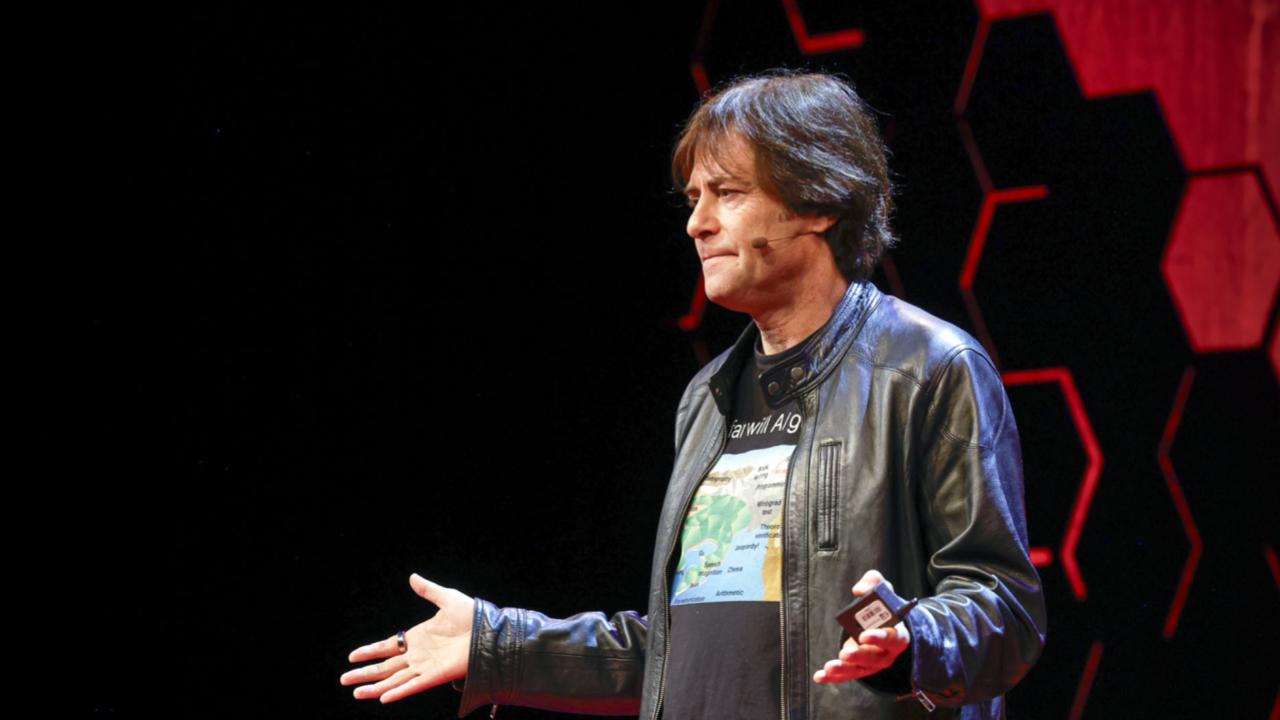
Max Tegmark

Max Erik Tegmark (born 5 May 1967) is a Swedish-American physicist, machine learning researcher and author.

He is best known for his book Life 3.0 about what the world might look like as artificial intelligence continues to improve. Tegmark is a professor at the Massachusetts Institute of Technology and the president of the Future of Life Institute.

OnAir Post: Max Tegmark

Anthony Aguirre

Anthony Aguirre (born 1973) is a theoretical cosmologist. Aguirre is a professor and holds the Faggin Presidential Chair for the Physics of Information at the University of California, Santa Cruz.

He is the co-founder and associate scientific director of the Foundational Questions Institute and is also a co-founder of the Future of Life Institute.  In 2015, he co-founded the aggregated prediction platform Metaculus with Greg Laughlin. In 2019, he published the pop science book Cosmological Koans.

OnAir Post: Anthony Aguirre

Machine Intelligence Research Institute (MIRI)

The Machine Intelligence Research Institute (MIRI), formerly the Singularity Institute for Artificial Intelligence (SIAI), is a non-profit research institute focused since 2005 on identifying and managing potential existential risks from artificial general intelligence.

MIRI’s work has focused on a friendly AI approach to system design and on predicting the rate of technology development.

In 2000, Eliezer Yudkowsky founded the Singularity Institute for Artificial Intelligence with funding from Brian and Sabine Atkins, with the purpose of accelerating the development of artificial intelligence (AI).  See onAir post.

Source: Wikipedia

OnAir Post: Machine Intelligence Research Institute (MIRI)

Eliezer Yudkowsky

Eliezer S. Yudkowsky (born September 11, 1979) is an American artificial intelligence researcher and writer on decision theory and ethics, best known for popularizing ideas related to friendly artificial intelligence.

He is the founder of and a research fellow at the Machine Intelligence Research Institute (MIRI), a private research nonprofit based in Berkeley, California. His work on the prospect of a runaway intelligence explosion influenced philosopher Nick Bostrom’s 2014 book Superintelligence: Paths, Dangers, Strategies.

OnAir Post: Eliezer Yudkowsky

Institute for AI Policy and Strategy (IAPS)

The Institute for AI Policy and Strategy (IAPS) is a think tank of aspiring wonks working to understand and navigate the transformative potential of advanced AI. Our mission is to identify and promote strategies that maximize the benefits of AI for society and develop thoughtful solutions to minimize its risks.

We aim to be humble yet purposeful: we’re all having to learn about AI very fast, and we’d love it if you could join us in figuring out what the future holds together.

Source: LinkedIn

OnAir Post: Institute for AI Policy and Strategy (IAPS)

Millennium Project

The Millennium Project is a global participatory think tank established in 1996 under the American Council for the United Nations University. We became an independent non-profit in 2009 and we now have 72 Nodes (a group of institutions and individuals that connect local and global perspectives) around the world.

Purpose: Improve humanity’s prospects for building a better future.

Mission: Improve thinking about the future and make that thinking available
through a variety of media for feedback to accumulate wisdom about the future for better decisions today.

Vision: A global foresight network of Nodes, information, and software, building a global collective intelligence system recognized for its ability to improve prospects for humanity. A think tank on behalf of humanity, not on behalf of a government, or an issue, or an ideology, but on behalf of building a better future for all of us.

OnAir Post: Millennium Project

Jerome C. Glenn

Jerome C. Glenn co-founded and directs The Millennium Project, a leading global participatory think tank supported by international organizations, governments, corporations, and NGOs, which produces the internationally recognized State of the Future annual reports for the past 16 years.

Jerome Glenn invented the “Futures Wheel”, a futures assessment technique; Futuristic Curriculum Development, and concepts such as conscious-technology, transinstitutions, tele-nations, management by understanding, feminine brain drain, just-in-time knowledge, feelysis, nodes as a management concept for interconnecting global and local views and actions, and definitions of environmental security, Collective Intelligence, and scenarios.

Association for the Advancement of Artificial Intelligence

The Association for the Advancement of Artificial Intelligence (AAAI) is an international scientific society devoted to promote research in, and responsible use of, artificial intelligence.

AAAI also aims to increase public understanding of artificial intelligence (AI), improve the teaching and training of AI practitioners, and provide guidance for research planners and funders concerning the importance and potential of current AI developments and future directions.

OnAir Post: Association for the Advancement of Artificial Intelligence

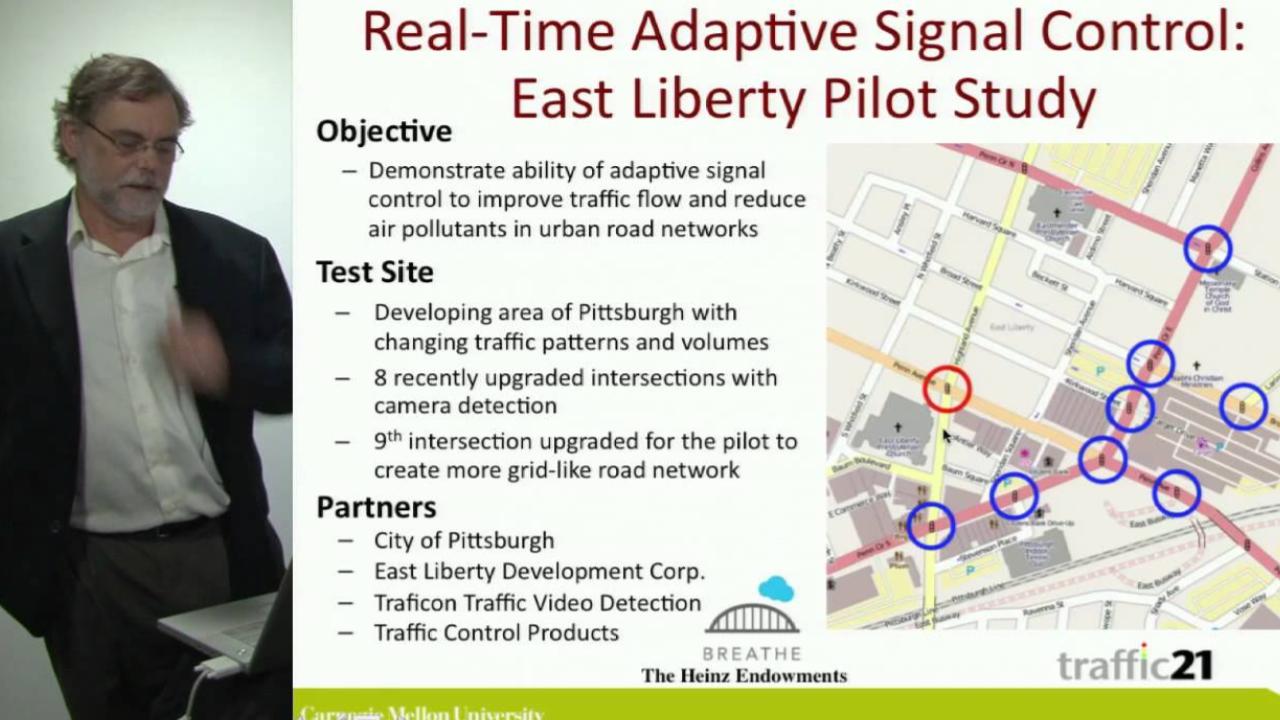
Stephen Smith

Current President of AAAI,

His  research interests are in artificial intelligence, primarily in the areas of constraint-based search and optimization, automated planning and scheduling, configurable and adaptive problem solving systems, multi-agent and multi-robot coordination, mixed-initiative decision-making, and naturally inspired search procedures. One integrating focus has been the development of core technologies for coordination and control of large-scale, multi-actor systems, and their application to domains spanning transportation, manufacturing, logistics, mission planning, and energy systems.

OnAir Post: Stephen Smith

onAir Networks

onAir Networks are human-curated, AI-assisted online networks of topical Hubs similar to real world town halls and think tanks.

We bring together professionals, administrators, students and the public to:
LEARN more about a field and advance its knowledge
DISCUSS key challenges
ENGAGE with others to co-create solutions

Together, we can build knowledge-based, trusted, collaborative online communities to create a “People’s Internet” 

  • Where onAir hub members own their content & share their profiles and projects with related hubs without being tracked, algorithmic feeds, or intrusive ads;
  • Where public posts are curated and shared by members without paywalls integrating AI summaries with their own knowledge; spotlighting the latest news, videos, and projects; moderating discussions, and hosting livestreamed interviews and events;
  • Where every person can participate and thrive

Join us & help us reclaim the web. Your voice matters onAir!

Todd Gillette

Todd Gillette is CTO for onAir Tech, a startup chartered in Virginia building an innovative knowledge sharing platform. Todd is also Chair of onAir Networks, the 501c3 nonprofit overseeing the implementation of the onAir platform for public online networks.

Todd currently serves as a Staff Software Engineer at Northrop Grumman Corporation’s Mission Systems. Todd earned his PhD in Neuroscience in 2015 from George Mason University, having researched informatics and data analytics methods applied to neuronal morphology and function. He holds a BS in Engineering and BA in Computer Science from Swarthmore College.

Along with his many years working with software, Todd’s experience includes mission engineering and systems engineering, determining and documenting the key problems to be solved, deriving requirements, architecting and evaluating candidate solutions, and verifying designs and implementations. He has worked with cyber systems and software engineers to address anti-tamper and unintended emissions concerns and to integrate defensive and offensive cyber capabilities.

Todd has also studied and applied artificial intelligence, including machine learning and logical ontology-based techniques. The intersections of AI and biological brains, and how to leverage them to enhance human capabilities in an ethical and human-centered manner, continue to be one of Todd’s primary interests.

OnAir Post: Todd Gillette

Scott Joy

Chair, onAir Tech, a Public Benefit Corporation
Curation Director,  onAir Networks, a 501 c3
Chair, Future onAir Advisory Board

Interests:  Knowledge Networks, Catalyzing Innovation, Tech Entrepreneurship, Healthy and Sustainable Communities

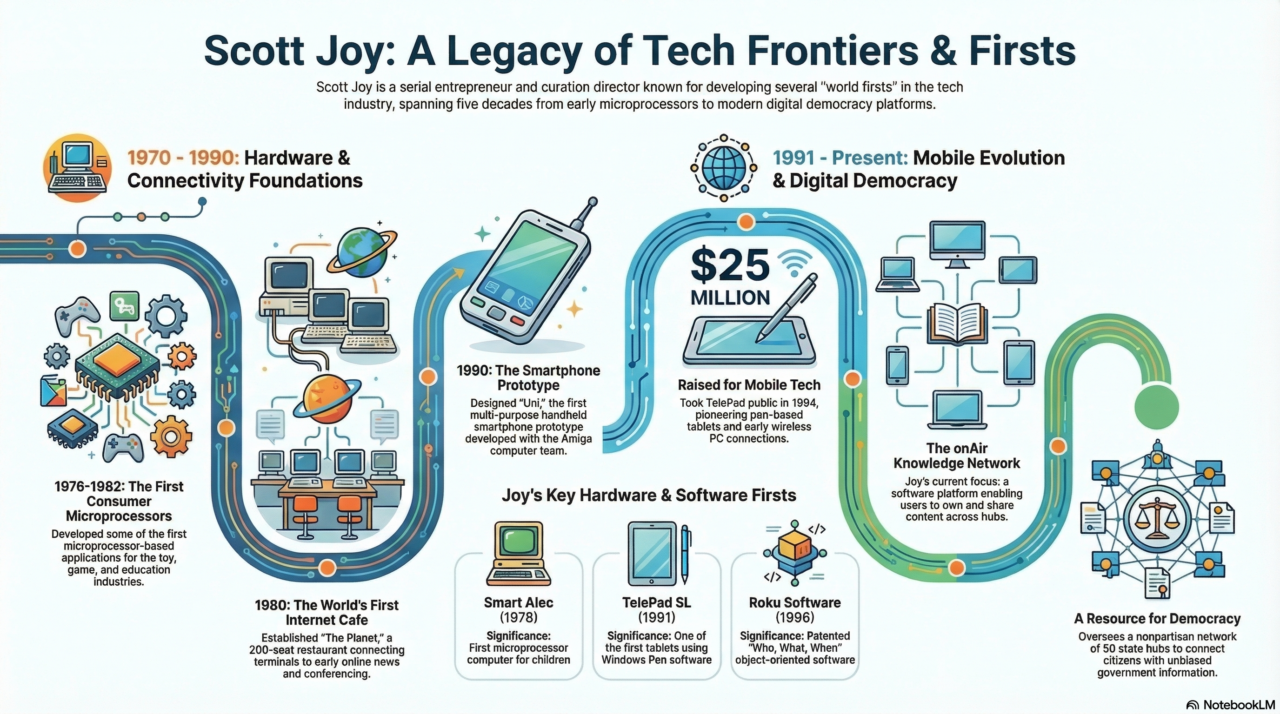
Pioneer in identifying, developing, and applying new information and communication technologies:

  • The first consumer applications of the microprocessor (4bit & LSIs) … for the toy and game industry and for education
  • The first internet cafe with online news, games, and computer conferencing
  • The first prototype smartphone working with the developers of the Amiga computer, the first graphical computer

My current focus is developing a network of onAir hubs based on a new knowledge sharing software platform with many unique features such as enabling authors to own and share their content across multiple public and custom Hubs.   Current hub that is being established to bring together people interested in implementing a People’s Internet is at people.onair.cc.

OnAir Post: Scott Joy

Skip to toolbar